Traditional German Christmas food mixes spiced bakes such as stollen and lebkuchen, market drinks like glühwein, and a holiday table built around roast goose with red cabbage. Most dishes trace back to specific cities, trade routes or church rules.
Each dish below is placed in its region and served the way Germans traditionally eat it. For the wider picture, see our guide to traditional holiday foods around the world.
Why the German Christmas menu looks the way it does
Three forces explain most of what ends up on a German Christmas table: spice trade, religious rules about ingredients, and regional produce. Knowing them makes it easier to tell a dish’s real origin from its modern market version.
Trade routes and spices
Lebkuchen is the clearest example. According to a Milwaukee Journal Sentinel feature on German Christmas baking, this dense-spiced gingerbread was first baked in Nuremberg in 1395. The city sat on the ancient spice and trade routes, which made cinnamon, allspice and cloves readily available to its bakers. By 1643 Nuremberg had even created a League of Lebkuchen Bakers, so the bake was organised as a trade long before it became a souvenir.
Church rules and richer dough
Stollen shows how a rule change reshaped a recipe. The same feature says stollen was first baked as a Christmas pastry around A.D. 1400. A papal declaration issued in 1647, known as the Butterbrief, allowed butter to be used as an ingredient. That is why the stollen people buy today is a rich, buttery loaf.
Regional produce
Regional cooking fills in the rest. Rosetta Stone’s guide to German Christmas food describes southern Germany as favouring rich dishes of slow-braised meats with potatoes and vegetables, while the north leans on late-season harvests and fishing. When planning a menu, treat the south as the model for braised and roasted centrepieces and the north as the place to look for fish and harvest-based dishes.
Stollen and lebkuchen: the bakes behind the markets
What is stollen?
Stollen is a Christmas pastry first baked around A.D. 1400, and its modern butter-enriched form dates from the 1647 Butterbrief. Dresden’s version is the best known. It is flavoured with candied lemon and orange peel, citron and nuts, and rum-soaked raisins, according to the Milwaukee Journal Sentinel.
The city’s Striezelmarkt is considered the oldest German Christmas market still in existence. The Dresden Stollen Festival has featured a largest loaf of more than 2 tons’ worth of stollen, which shows how central the loaf is to the city’s identity.
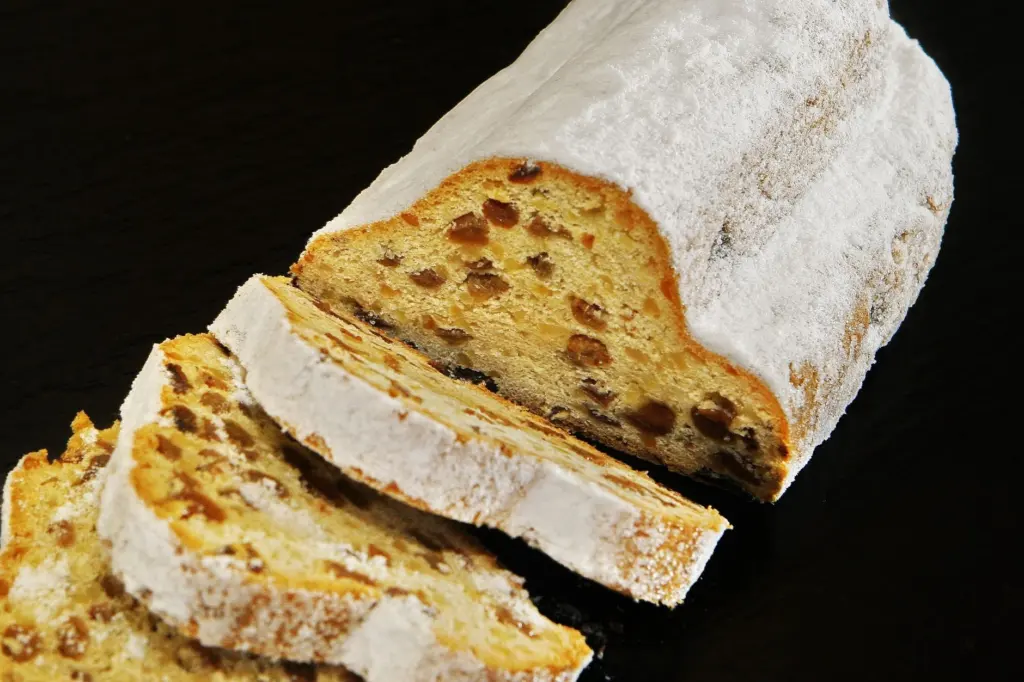
Lebkuchen
Lebkuchen is the Nuremberg counterpart. Its spice profile of cinnamon, allspice and cloves comes straight from the city’s trade position, and honey is the sweetener. Choose lebkuchen over stollen when you want something spiced and compact to eat while walking; choose stollen when you want a sliceable loaf to share at the table.
Dishes at a glance
The table below puts the market and holiday-table staples side by side, so you can see where each belongs and what goes into it.
| Dish | Origin or setting | Typical ingredients | Planning use |
|---|---|---|---|
| Stollen | Dresden; first baked as a Christmas pastry around A.D. 1400 | Candied lemon and orange peel, citron, nuts, rum-soaked raisins | Look for the Dresden seal when you want the regional version |
| Lebkuchen | Nuremberg; first baked in 1395 | Cinnamon, allspice, cloves, honey | Pair with a mug of glühwein while strolling the market |
| Glühwein | Christmas market drink | Red or white wine, mainly cinnamon and cloves | Choose it as the warming drink between stalls |
| Weihnachtsgans (roast goose) | Holiday table | Apples, onions, chestnuts, herbs | Plan it as the centrepiece roast |
| Kartoffelpuffer | Christmas markets | Pan-fried potato pancakes with applesauce | Order when you want a savoury break from sweets |
Figures and ingredients come from the Milwaukee Journal Sentinel and Rosetta Stone.
Christmas market food and drink
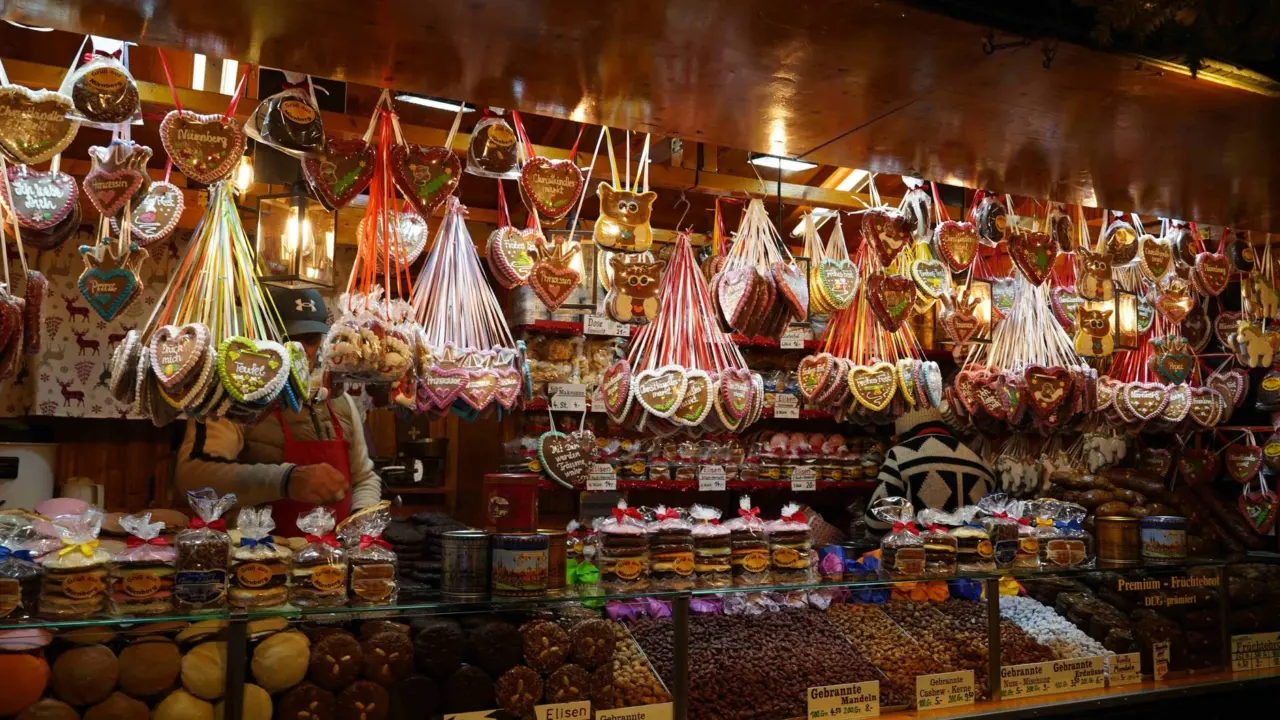
A German Christmas market centres on sweet bakes, a hot drink and a few savoury stalls. Lebkuchen and stollen are the sweet staples, glühwein is the drink, and Kartoffelpuffer, pan-fried potato pancakes served with applesauce, are the savoury option.
The Milwaukee Journal Sentinel describes strolling the Nuremberg square while eating lebkuchen and drinking glühwein as a market ritual. That combination is the simplest way to start: one sweet, one hot drink, then a savoury stall.
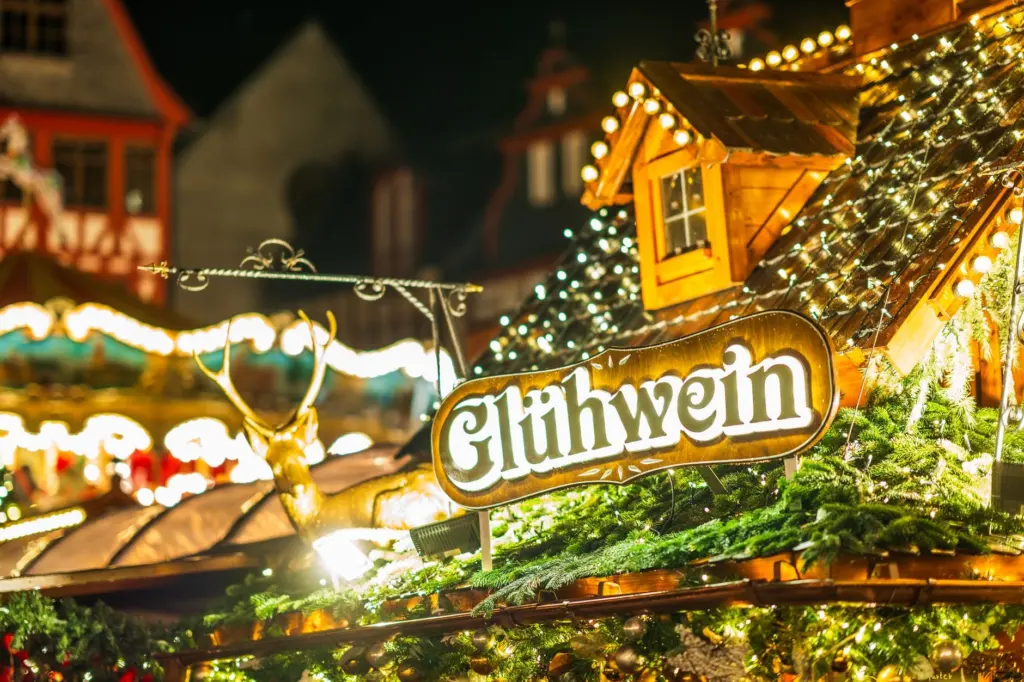
Glühwein
Glühwein is hot mulled wine. Rosetta Stone notes that it can be made with either red or white wine, spiced primarily with cinnamon and cloves. Since both colours are traditional, the choice comes down to taste: red gives a heavier, spicier mug, while white is the alternative for anyone who prefers it.
The Christmas table: goose, red cabbage and Rouladen
Roast goose
Weihnachtsgans is the classic holiday roast. Rosetta Stone says it is stuffed with apples, onions, chestnuts and herbs, then roasted in the oven for crispy skin and tender meat. The fruit and chestnuts add sweetness to the stuffing, which suits a rich bird.
Red cabbage
Red cabbage is the usual companion. Recipes from Europe describes it as made with red cabbage, apples, onions and aromatic spices, and says it goes well with meat dishes like Rouladen, Sauerbraten or pork roast. It appears under several names: Rotkraut, Rotkohl and Blaukraut. If you see any of them on a menu, you are looking at the same side.
A Christmas calendar
Timing matters as much as the dishes. A typical sequence runs as follows:
- Market visits: sweets, glühwein and Kartoffelpuffer are the food of the market stroll rather than the family meal.
- Christmas Eve: Recipes from Europe notes that celebrating Christmas on December 24th is common in Germany, so that is the evening to plan a main meal around.
- Christmas Day and the day after: Rouladen is usually made on December 25th or 26th, served with red cabbage.
Which dish lands on which evening varies by household and region. The sequence is a guide, not a rule.
Plätzchen: the cookies that fill the tins
Plätzchen is the German word for small Christmas cookies. Recipes from Europe calls Butterplätzchen another classic German Christmas cookie: butter cookies cut with cookie cutters and topped with icing or sprinkles. Because the dough takes cutters and decoration easily, it suits anyone baking with children or building a mixed tin.
Lebkuchen sits in a different category. It is a spiced gingerbread tied to Nuremberg, while Plätzchen is a broad family of cookies baked at home.
Comparing national food symbols
German Christmas dishes belong to a season rather than a nation. For contrast, see how a single dish becomes a national emblem in Is Paella Spain’s National Dish? The Complete Guide To Spain’s Culinary Symbol (2026) – Asmallbite and What Is Canada’s National Dish? Poutine, Pride, And Regional Flavors In 2026 – Asmallbite.
Frequently asked questions
Who can use the official Dresden stollen seal?
Only 140 Christmas cake bakers in the Dresden area hold the seal, according to the Milwaukee Journal Sentinel.
What is Feuerzangenbowle?
It is a dramatic variation on mulled wine. Rosetta Stone describes setting a rum-soaked sugarloaf, or sugar cubes, on fire above the mug of mulled wine.
What is Spritzgebäck?
Spritzgebäck is a German Christmas spritz cookie. Recipes from Europe says it is relatively easy to make into any shape, and it can be dipped in chocolate.