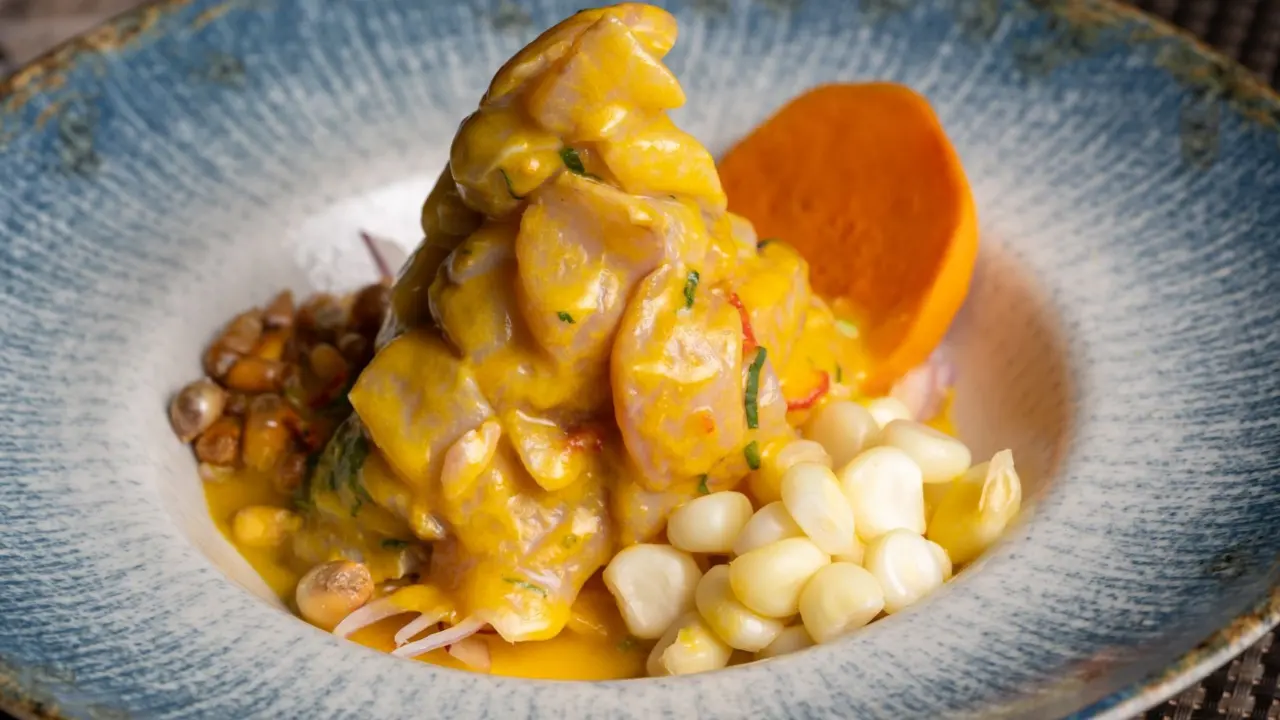
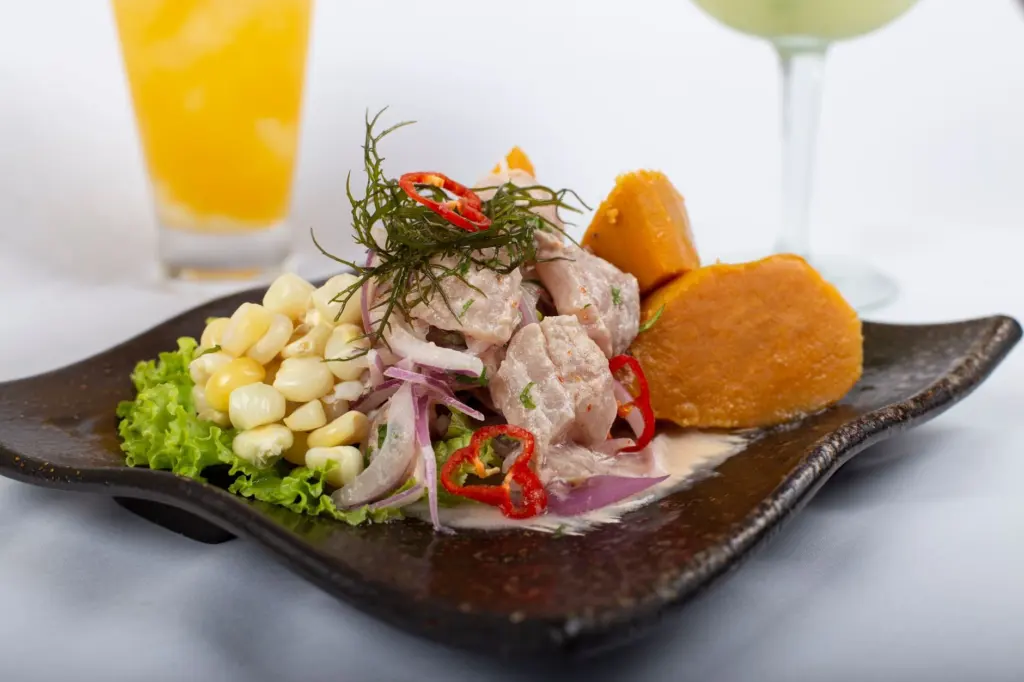
The national dish of Peru is ceviche: raw fish cured in citrus juice, finished with chili and served with sweet potato and corn. It earns that status through a long coastal history and a method that has stayed deliberately simple.
Ceviche also belongs to a wider story of dishes tied to place and ritual, which the guide to traditional holiday foods around the world sets in context. Here the dish is followed from the plate back through its history.
How ceviche is made today
Peruvian ceviche is a short, cold method. As a Peru food guide describes it, you cure raw fish in citrus juices and then spice it with chili. No heat is involved, so the quality of the fish and the timing of the citrus decide the result.
- Cure the raw fish in citrus juice. Lime is the juice most associated with the dish, and the fish is the centre of the plate.
- Add the chili. The heat and seasoning go in after the cure, not before it.
- Serve almost at once. Authentic Peruvian ceviche is served within fifteen minutes after the lime touches the fish, according to this account of the dish.
- Plate it with its accompaniments. Sweet potato, onion and corn are the usual company.
The third step is the one that most separates today’s ceviche from older versions. Fish was historically marinated in lime juice for far longer, so a recipe that calls for a long soak follows an older practice rather than the current Peruvian standard. If you are cooking at home, treat the lime as a brief contact and plan the rest of the meal so the plates can go out immediately.
How history shaped the method
Each step above has a historical reason. The fish-and-citrus idea is older than the citrus itself, the lime arrived through trade, and the cooking around it was reshaped by later migration. The timeline below links each layer to what ends up on the plate.
| Period | Development | What it means for the dish |
|---|---|---|
| Moche era, pre-Inca and pre-citrus | Coastal society that many scholars credit with developing early ceviche | Curing fish on the coast predates the lime |
| Spanish and Portuguese trade | Bitter oranges arrived first, followed by lemons and limes | Explains the citrus now central to the cure |
| Between 1848 and 1874 | Chinese immigrants arrive and shape Peru’s fusion cooking | Adds to the fusion background of Peruvian kitchens |
| 1899 | Japanese immigrants arrive with seafood preparation traditions | Brings seafood preparation traditions into the coastal kitchen |
| About 60 years ago | Ceviche becomes popular in Lima | Marks the dish’s rise in the city, not its invention |
These milestones draw on an account of ceviche’s origins and a guide to Peruvian cuisine.
The lime marinade also replaced something. On the coast, a Peruvian travel guide notes that cooks marinate the fish with lime juice instead of the traditional fermentation. That detail is useful when judging recipes: lime is a later layer on an older coastal idea, which is why the method can be so brief and still count as traditional.
Food origin stories often turn out to be layered in this way. Readers who enjoy tracing them can compare this one with The History Of Tea: From Ancient Legends To Global Rituals — A Concise 2026 Overview – Asmallbite or with the history of pasta.
Traditional ingredients
A traditional plate needs few components, and each has a defined role. Use this list as a shopping guide for a Peruvian-style plate.
- Raw fish and citrus juice. The fish is cured in lime juice. The fish-and-lime marinade is called leche de tigre, a name that applies to the liquid itself.
- Aji amarillo. This yellow chili pepper is a condiment and seasoning used in many dishes of the coast, so it gives ceviche the same flavour base as other coastal cooking, as Discover Peru explains.
- Onion. It is one of the three companions, alongside sweet potato and corn, that a Peru food guide lists as the usual accompaniments.
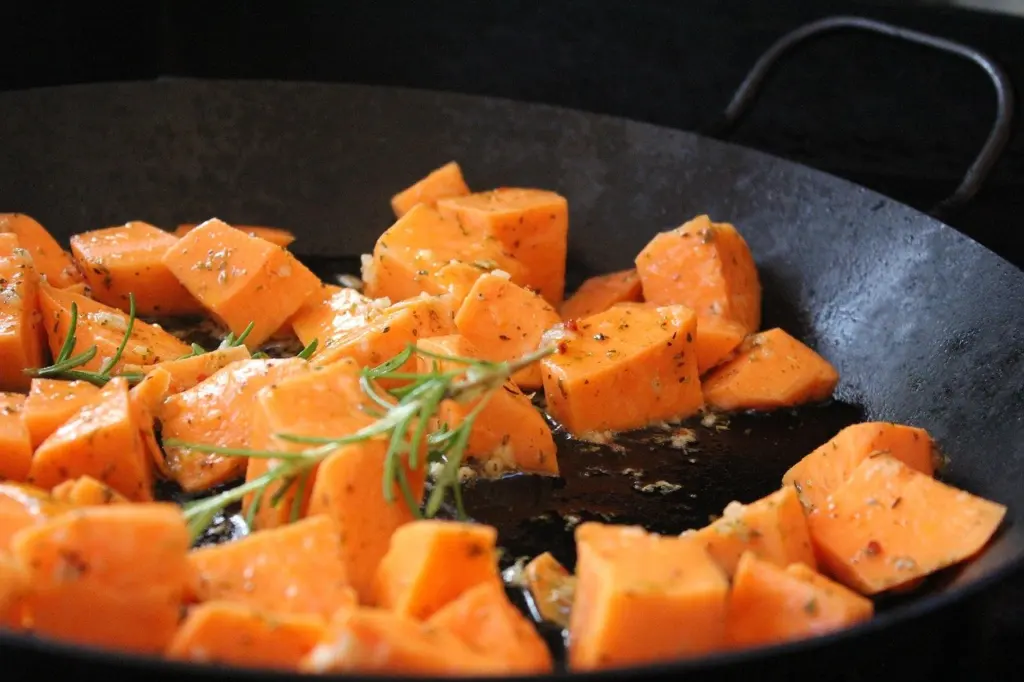
- Sweet potato (camote). The traditional accompaniment is named camote in Peru.
- Giant-kernel corn (choclo). It is the other traditional accompaniment, as an account of the dish records.
Sweet potato and corn are the accompaniments sources name as traditional, so a plate without them is a departure from the classic. If you are building a plate for guests, treat them as part of the dish rather than as optional garnish.
Why ceviche stands for Peru
Ceviche is the national dish of Peru because it combines three things in one plate: wide popularity, local ingredients and a history made of several layers. Discover Peru’s food guide says that perhaps the most popular dish is ceviche, which is the simplest explanation for its place at the top of the national menu.
The second reason is that its parts are recognisably Peruvian. Aji amarillo is a seasoning of the coast, and camote and choclo are the named traditional accompaniments. The third is that the dish carries the country’s story: an early coastal origin credited to the Moche-era, citrus brought by traders, and fusion cooking shaped by later arrivals. A national dish tends to be one that people can claim as their own, and ceviche invites that claim because each wave of history left something in it.
Ceviche across regions
The pack’s evidence points to a clear pattern: ceviche is a coastal dish, and inland regions are known for their own signature plates.
Lima and the coast
Lima is described as the beating heart of Peru’s culinary scene, which makes it the natural place to compare how cooks treat the same dish. The city is also a major centre of culinary fusion, according to a guide to famous Peruvian foods. If your aim is to taste ceviche, the coast and Lima are the most reliable places to look, and the fusion scene gives the widest range of interpretations.
Inland specialties
Moving away from the sea, the menu changes. Rocoto relleno is a specialty of the city of Arequipa, as a Peru food guide notes. Papa a la huancaína takes its name from Huancayo, a highland city about 300km east of Lima, according to the same Peruvian food guide. These dishes are not ceviche variants. They show that a trip beyond the coast is better spent ordering the local specialty than looking for a seafood dish designed for the sea.
Frequently asked questions
When is ceviche usually eaten in Peru?
Ceviche, like most Peruvian seafood, is typically served only for lunch, according to a Peru food guide.
How long was ceviche traditionally marinated?
Older practice marinated fish in lime juice for 12 to 24 hours, as an account of the dish records. That is a very long cure compared with the modern serving window.
Which typical food comes from the Cusco region?
Chiriuchu is a typical food from the Cusco region of Peru, according to a Peruvian travel guide.