| Decision | Supported value | Planning use |
|---|---|---|
| Batch size and pan | 6 rolls in an 8×8 or 9×9-inch pan; 12 rolls in a 9×13-inch pan when doubled | Bake six for one small household. Double only when feeding a crowd. |
| First rise | 45 to 60 minutes, until puffy but not necessarily doubled | Judge the dough by how it looks, not by the clock alone. |
| Shaped rolls | 45 to 60 minutes, covered in the pan | Allow this time before you heat the oven. |
| Oven setting | 350°F for 18 to 20 minutes (Joy the Baker); 375°F for 15 to 18 minutes (King Arthur) | Pick one pairing and start checking at the shorter time. |
| Doneness | 190°F in the center of one roll | A thermometer removes the guesswork from a small pan. |
| Make-ahead | 8 to 12 hours in the refrigerator, then 30 to 45 minutes on the counter | Shape the evening before and bake the next morning. |
Figures come from King Arthur Baking’s small-batch cinnamon roll recipe and Joy the Baker’s small-batch cinnamon rolls.
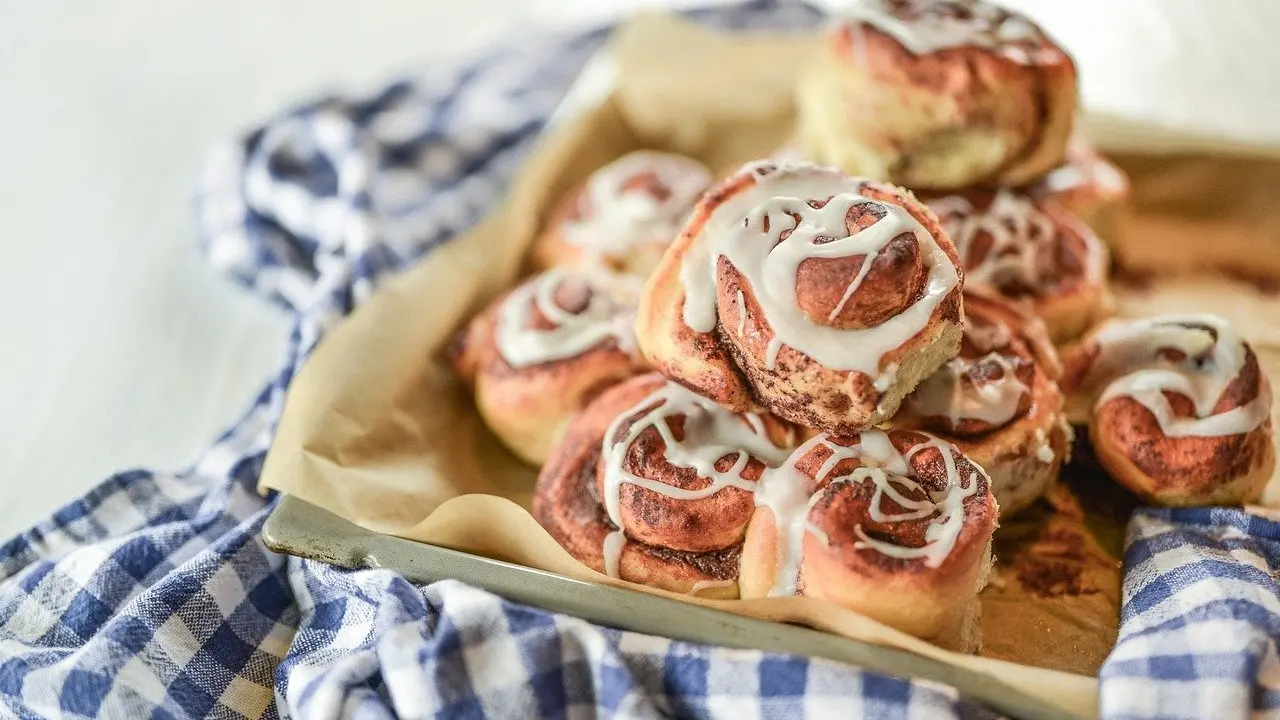
A small batch cinnamon roll recipe makes sense when six rolls are enough: Joy the Baker bakes that many in an 8×8 or 9×9-inch pan. Measure carefully, because small quantities leave little margin for error.
These rolls suit a slow weekend morning. When the same small-household thinking is needed for supper, browse our easy weeknight dinner recipes.
Choosing your batch size
Published small-batch cinnamon roll recipes do not agree on one number, so the batch size is your decision. Match it to how many people will eat the rolls while they are warm.
- Six regular rolls: Joy the Baker, Honeyed Sundays and The Salted Sweets all land on six. This is the safest choice for a couple or a small family, and the recipe below follows it.
- Just two rolls: King Arthur yields only two, which suits a solo baker who wants to skip leftovers altogether.
- Twelve mini rolls: Honeyed Sundays makes the same dough as 12 minis. Choose this when you want bite-sized portions for a brunch table.
- A full dozen regular rolls: Joy the Baker doubles the batch to 12 rolls in a 9×13-inch pan. Reach for this only when you are feeding a crowd.
Whichever size you choose, the dough, rising and baking steps below stay the same. Only the pan and the bake time shift.
Ingredients and quantities
The quantities below follow Joy the Baker’s recipe for six rolls. They are small enough that a few spoonfuls too much or too little will change the dough.
Dough
- Yeast: 1 1/2 teaspoons active dry yeast.
- Milk: 1/2 cup whole milk, warmed to just warmer than body temperature, about 110 degrees F.
- Butter: 2 tablespoons unsalted butter.
- Brown sugar: 2 tablespoons.
- Flour: 1 1/2 to 2 cups (187 to 250 g) all-purpose flour, plus more for dusting.
- Egg: 1 large egg yolk.
The flour comes as a range, so add it gradually and stop at the lower end if the dough already holds together. Bread flour also works: The Salted Sweets uses 1 1/4 to 1 2/3 cups (156.25 g) bread flour and says all-purpose can stand in. That recipe uses salted butter, which is a matter of taste.
Filling
- Butter: 6 tablespoons unsalted butter, melted and divided.
- Brown sugar: 1/2 cup (100 g), lightly packed.
- Cinnamon: 1 teaspoon.
Cinnamon-heavy fans can look at The Salted Sweets, which uses 1/3 cup (73.33 g) light brown sugar with 2 teaspoons of cinnamon and 1 1/2 tablespoons of butter. It makes a drier, spicier filling than the one above.
Rise times and warmth
Dough should rise for 45 to 60 minutes in the first rise, and about the same again once the rolls are shaped. The recipes differ in what they ask you to look for, which matters more than the exact minutes.
King Arthur lets the dough rise until puffy but not necessarily doubled, 45 to 60 minutes. Honeyed Sundays waits for the dough to double in a warm place, which takes 1 to 2 hours. Joy the Baker covers the dough and rests it for 30 minutes before shaping.
- In a cool kitchen: Plan for the longer end of the range and judge by the dough, not the timer.
- In a warm kitchen: Check at the shorter end, because The Salted Sweets notes that its 45 to 60 minute second rise depends on how warm the room is.
- For the shaped rolls: King Arthur gives 45 to 60 minutes covered in the pan, while Honeyed Sundays rises the rolls for another 30 minutes on a parchment-lined sheet pan.
Warm the milk gently, because Joy the Baker’s target is only just warmer than body temperature, about 110 degrees F. A thermometer takes the guesswork out of that step.
Filling and shaping the rolls
Roll the rested dough out, brush it with melted butter, and scatter the brown sugar and cinnamon evenly to the edges. Roll it up tightly from the long side and cut the log into six pieces to match the batch size above.
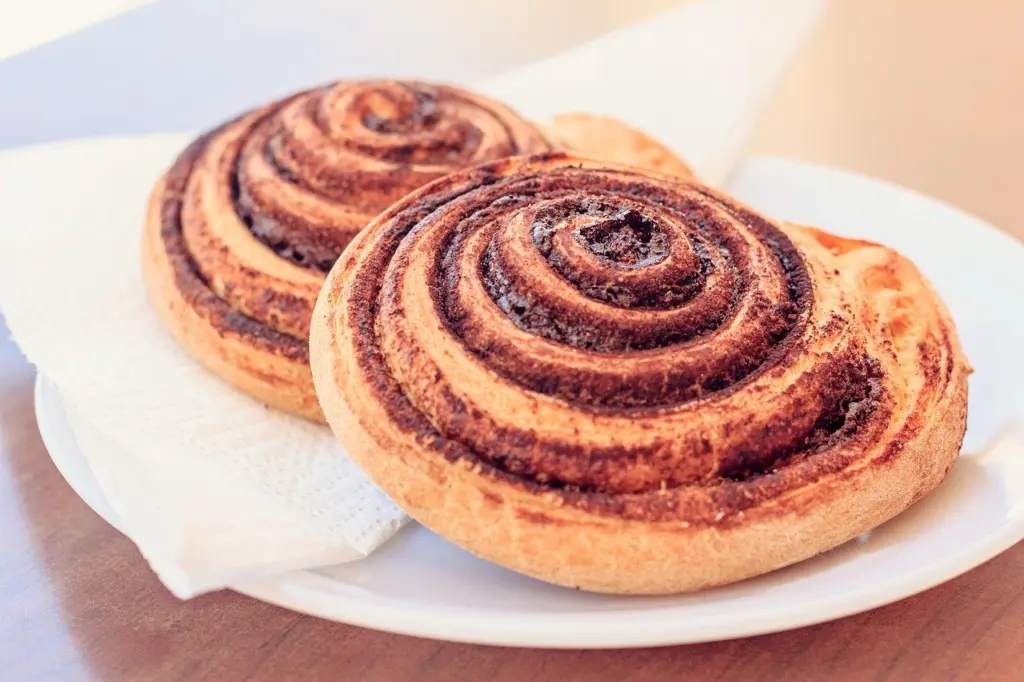
A tight roll keeps the spiral intact once the rolls bake and puff. Use a sharp knife or unflavored thread for clean cuts so the layers are not squashed.
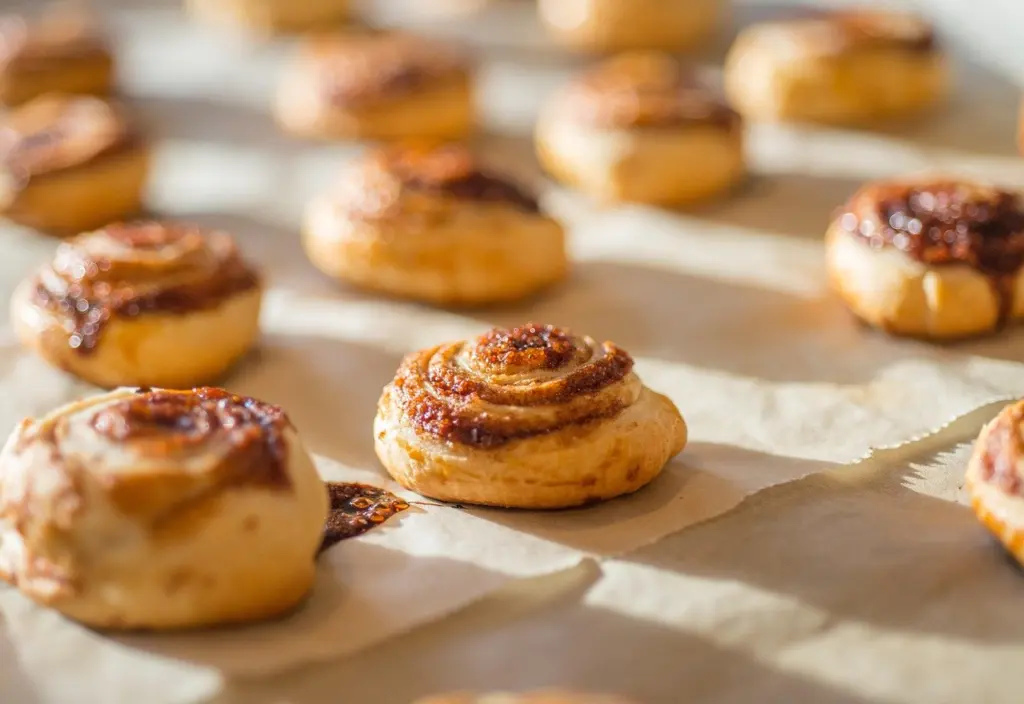
Place the cut rolls in the pan with a little room between them, since they will grow during the second rise. Cover the pan and let it rise, using the shaped-roll timings in the previous section.
Baking and doneness
Bake at 350°F for about 18 to 20 minutes, or at 375°F for a shorter time. Both temperatures are used by reputable small-batch recipes, so choose one pairing and keep it.
- 350°F: Joy the Baker bakes for 18 to 20 minutes until golden brown, and Honeyed Sundays gives 18 to 22 minutes until lightly golden and puffed. This gentler setting suits a dense pan of six rolls.
- 375°F: King Arthur bakes for 15 to 18 minutes, and The Salted Sweets gives 12 to 18 minutes until the tops are light golden brown. Choose this if you prefer more color in a shorter bake.
The wide ranges exist because ovens and pans differ. Start checking at the shorter time. King Arthur’s test is a digital thermometer in the center of one roll, which should read 190°F. That reading is more reliable than color alone when the pan is crowded.
Cream cheese glaze
A cream cheese glaze gives these rolls their classic tang, and the small quantity below covers six rolls. Joy the Baker’s glaze combines 2 ounces of softened cream cheese, 1 tablespoon of butter and 3/4 cup of powdered sugar, with 2 to 3 tablespoons of milk if you want it thinner.
- For a spreadable topping: Leave out the milk, so the glaze stays thick.
- For a drizzle: Add milk a spoonful at a time until it runs off the spoon.
Making them ahead
Yes, you can prepare these rolls ahead. Shape them, chill them overnight, and bake them the next morning after a short rest on the counter.
Two approaches exist, and they differ in where the rise happens:
- Rise first, then chill: King Arthur shapes the rolls, lets them rise in the pan, covers the pan and refrigerates it overnight. Rest the rolls at room temperature for 15 minutes before uncovering and baking, and expect the bake to run a few minutes longer.
- Rise in the refrigerator: Joy the Baker lets the rolls rise in the refrigerator for 8 to 12 hours, then leaves them on the counter for 30 to 45 minutes before baking.
- Cover and rest longer: The Salted Sweets covers the pan in plastic wrap overnight and rests it for about 45 minutes before baking.
Choose the shorter rest if the rolls rose before chilling, and the longer rest if they were shaped and chilled straight away. Cold rolls need time to lose their chill before the oven.
Why small batches reward precise measuring
A small recipe has less dough to absorb mistakes. King Arthur says that in small-batch recipes ingredient quantities must be precise, and its recipe is aimed at small households.
Practical consequences follow. Weigh the flour where the recipe gives grams, level the yeast spoon, and measure the milk instead of eyeballing it. These habits matter most for the flour range, since the difference between 187 and 250 grams changes how the dough handles.
What to bake next
The same scaled-down thinking works beyond rolls. For a cookie that stays at a sensible size, try Perfect Small-Batch Sugar Cookies: The Quick 1-Dozen Recipe For Soft, Cuttable Cookies – Asmallbite. If you would rather have a loaf, an easy banana bread recipe needs only one bowl.
Frequently asked questions
Can I double this recipe?
Yes. Joy the Baker doubles the recipe to make 12 rolls in a 9×13-inch pan.
What pan works for a small batch?
The Salted Sweets bakes six rolls in a 9×4 loaf pan or an 8 to 9 inch round pan. King Arthur says its two-roll yield leaves plenty of flexibility to use whatever pan you have.
Can I use all-purpose flour instead of bread flour?
Yes. The Salted Sweets uses bread flour but notes that all-purpose can be used, and Joy the Baker’s recipe is written with all-purpose flour.
Can I make mini rolls?
Yes. Honeyed Sundays makes either 6 regular rolls or 12 mini from the same batch.