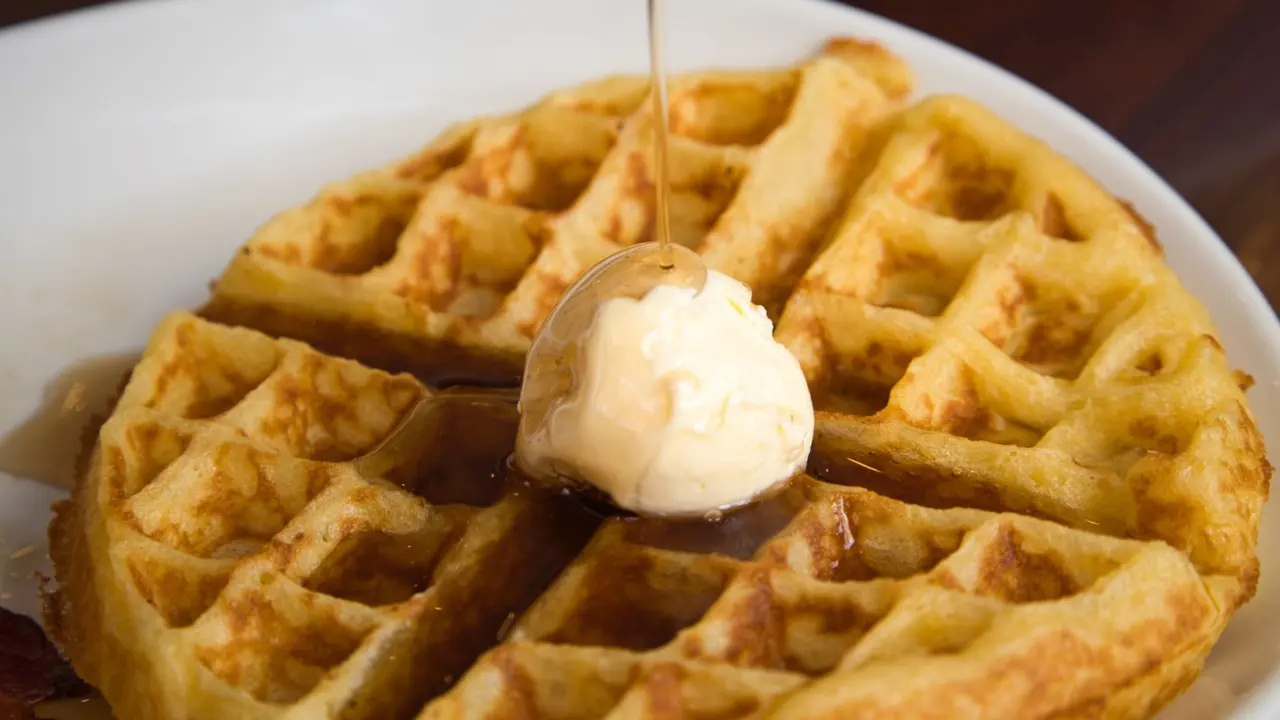
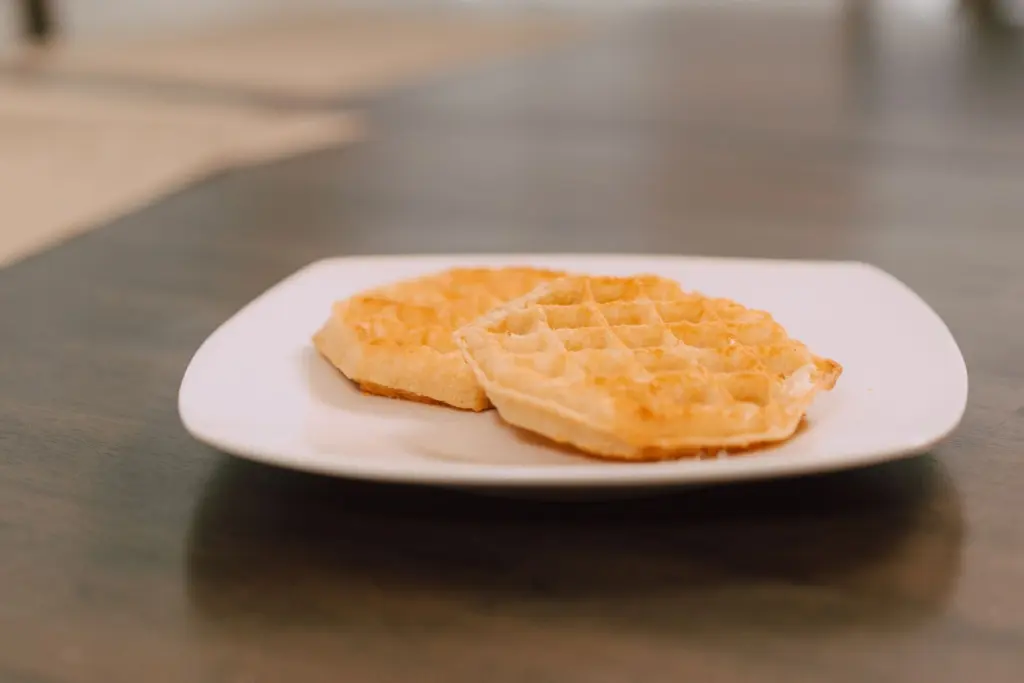
A small batch waffle recipe works when the batter is sized to your waffle iron: pour only what two waffles need, cook each until the steaming stops, and keep the rest of a bigger batch for later.
Two waffles is a task of measuring, not of inventing a new formula. If you cook for a small household, the easy weeknight dinner recipes collection has more dishes built on the same idea of making only what you will eat.
Sizing the batter for two waffles
Waffle yield depends on how much batter your iron takes, so size the batch by batter per waffle rather than by the flour in the bowl. Love and Lemons pours 1/2 cup of batter for each waffle into a Belgian waffle maker. Betty Crocker pours slightly less than 3/4 cup of batter onto the center of a hot waffle maker. An iron that takes a bigger pour makes fewer waffles from the same bowl, so measure your own iron’s pour once and repeat it for each waffle.
| Full-size recipe | Yield | Flour | Other quantities | Planning use |
|---|---|---|---|---|
| Love and Lemons | About 4 large waffles; serves 4 | 2 cups all-purpose, spooned and leveled | 1/2 cup (1 stick) unsalted butter, melted | The large-waffle yield makes this the closer starting point if you want to scale a recipe down to two waffles. |
| Natasha’s Kitchen | Serves 6; makes 12 regular waffles | 2 cups all-purpose, 250 g | 4 tsp baking powder, 1/4 tsp salt, 1 3/4 cups milk | Far more than two waffles, so it suits cooking two now and keeping the batter. |
Quantities are from the Love and Lemons waffle recipe and Natasha’s Kitchen fluffy waffle recipe.
Both recipes use 2 cups of flour, yet one makes about 4 large waffles and the other 12 regular ones. Flour alone therefore does not predict the count. Judge the batch by how many iron-fuls it fills, and decide between two routes.
- Scale a recipe down. Reduce every ingredient by the same share so the proportions stay intact. This suits you if you never want leftover batter and are happy to measure small amounts carefully.
- Mix the full batch and cook two. Natasha’s Kitchen says the batter can be covered and refrigerated for up to 5 days. This suits you if waffles will come round again within the week, because no ingredient is wasted and no tiny measurement is needed.
Ingredients and what each one does
A waffle batter has few parts, and each one has a job that shows up when you cut quantities down.
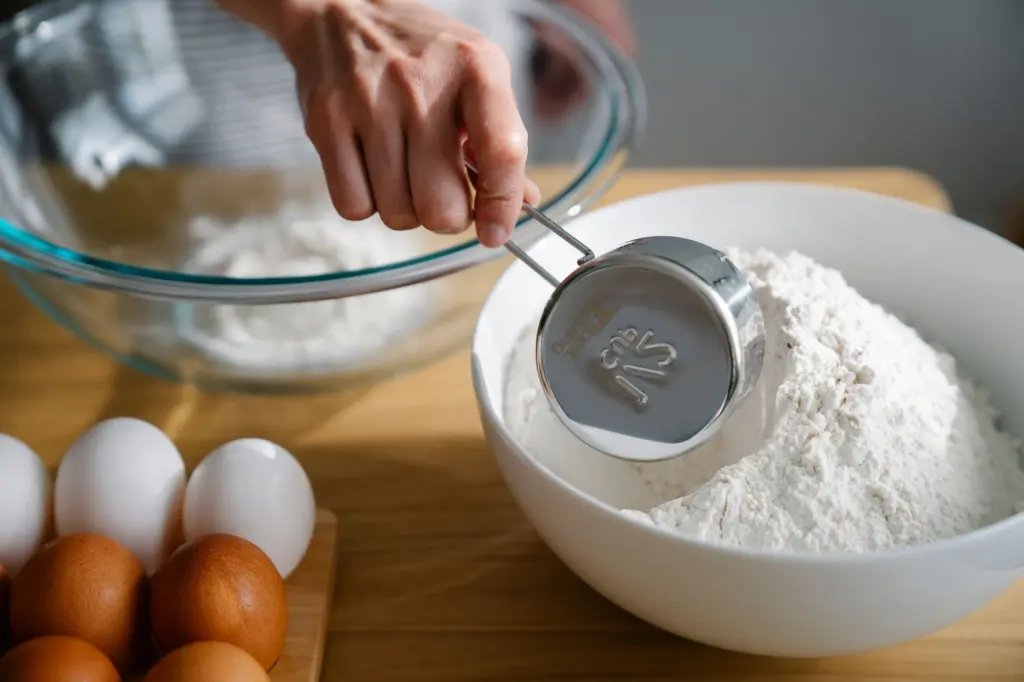
- Flour. All-purpose flour forms the body of the batter. Love and Lemons notes that 125 g equals 1 cup of flour when it is spooned and leveled, and Natasha’s Kitchen lists its 2 cups as 250 g. Weighing the flour with a kitchen scale cuts out the scooping variation that matters most in small amounts.
- Baking powder and egg. Love and Lemons says these two make the waffles airy, light, and fluffy. Natasha’s Kitchen stirs 4 tsp of baking powder and 1/4 tsp of salt into 2 cups of flour. When you scale down, keep the leavening in the same proportion to the flour rather than rounding it away, or the waffles will bake flatter.
- Milk and egg temperature. Love and Lemons recommends room-temperature milk and eggs. Take them out of the fridge before you start so they are ready when the iron is hot.
- Butter. The Love and Lemons batter contains 1/2 cup (1 stick) of melted unsalted butter, with more butter for serving. Melted butter is part of the liquid, so reduce it along with the milk.
- Waffle iron. The iron sets the portion. Its plates decide how much batter one waffle takes, and its heat decides how quickly that batter sets.
Method for two waffles
The sequence below applies to any scaled-down or full-size batter. Each step reflects the stages the cited recipes use.
- Preheat the iron fully before any batter goes near it.
- Set the milk and egg out so they reach room temperature.
- Stir the baking powder and salt into the flour in one bowl, and combine the milk, egg and melted butter in another.
- Pour the liquid into the flour mixture and stir only until combined, leaving the batter lumpy.
- Pour your iron’s measured amount into the center of the hot plates and close the lid.
- Cook until the steam stops, then lift the waffle onto a wire rack and repeat for the second.
Resting the batter and making it ahead
A short rest is useful in some batters and optional in others. MJ and Hungryman’s mini waffle recipe lets the batter sit for 5 to 10 minutes, and it gives the reason: the flour and oats need time to soak up the liquid. The rest therefore matters most for thicker, grain-heavy batters.
Resting also extends to storage. Natasha’s Kitchen advises that batter kept in the fridge should be lightly whisked before use, in case any ingredients have separated. That makes the full-batch route practical. Cook two waffles, cover the bowl, and whisk gently when you want the next pair.
Cook times and doneness
Cook times vary by iron, so treat every figure as a starting range and let the waffle tell you when it is done.
- Love and Lemons: 4 minutes, or until golden brown and lightly crisp.
- Natasha’s Kitchen: most waffles take 3 to 5 minutes.
- Betty Crocker: about 5 minutes or until steaming stops.
- Mini waffles: 4 to 5 minutes for a crispy waffle, and 2.5 to 3 minutes for a softer one that toddlers can eat.
The longer end of each range is for a crisper waffle. The steam cue is the most portable signal, because it does not depend on your iron’s wattage. If you want crisp edges, wait for the steam to stop and the surface to turn golden. If you want a softer, paler waffle, take it out toward the short end of the range.
Troubleshooting
Waffles that go soft or soggy
Soft waffles are usually a handling problem, not a batter problem. Cool each waffle on a wire rack, because Betty Crocker says this lets air hit both sides. Never stack hot waffles, which MJ and Hungryman warns against while they wait to be served.
With only two waffles you can usually serve straight from the iron. If you need to hold them, there are two oven approaches. MJ and Hungryman preheat the oven to 200°F and set a wire rack on a baking sheet. Natasha’s Kitchen keeps waffles warm at 175°F and avoids holding them longer than 30 minutes so they do not dry out.
When reheating leftover waffles, Betty Crocker advises adding toppings just before you heat them rather than ahead of time, so the waffle does not go soggy.
Waffles that turn out tough
Tough waffles point to overmixing. Natasha’s Kitchen explains that over-mixing develops the gluten more and results in tough waffles. Stop stirring while lumps remain, and do not chase a smooth batter. This matters more in a small batch, where a few extra turns of the whisk affect a larger share of the batter.
More small-batch cooking
If you like cooking for two without leftovers, Fudgy Small-Batch Brownies: The Easy 8–Piece Recipe For When You Only Want A Few (30 Minutes) – Asmallbite applies the same scaled-down approach to dessert. For a savory side project in the same quick style, try The Best Homemade Steak Sauce Recipe: Tangy, Savory, And Ready In 10 Minutes – Asmallbite.
Frequently asked questions
Does the kind of milk matter?
Natasha’s Kitchen lists 1 3/4 cups of milk, any kind, so use whatever you keep at home. Let it reach room temperature before mixing.
Can I make these in a mini waffle maker?
Yes. MJ and Hungryman use 1/4 cup of batter per mini waffle and get 9 waffles from their batch. Plan on more minis per person than full-size waffles.
What setting should the iron be on?
Natasha’s Kitchen sets its iron to 3 on an All-Clad press and adjusts to the desired crispness. Irons use different scales, so treat that number as a reference point, not a rule for your machine.